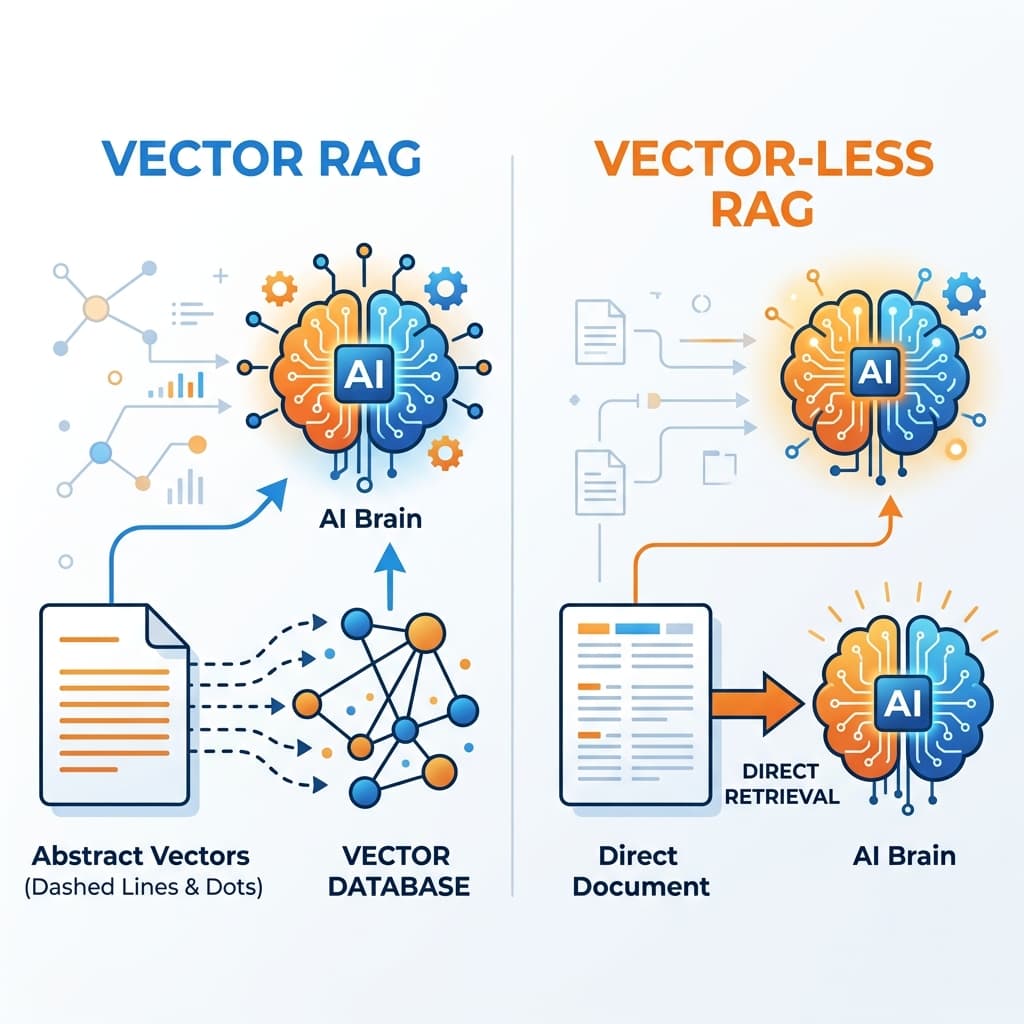
1. The Fundamental Problem: Why LLMs Need Retrieval (RAG)
Large Language Models (like GPT-4, Claude 3.5, and Llama 3) suffer from two notorious architectural constraints: knowledge obsolescence (their pretraining data cuts off at a static date) and factual hallucination (they generate plausible-sounding tokens when they lack verifiable facts).
Retrieval-Augmented Generation (RAG) solves this by turning closed-book generation into an open-book consultation. When a user submits a query, the RAG orchestration layer retrieves the exact relevant excerpts from your proprietary documentation, injects them into the prompt context window, and commands the LLM to synthesize an answer strictly grounded in those source chunks.
2. What is Vector RAG (Dense Semantic Retrieval)?
Computers do not interpret words with emotional semantics—they compute distances in high-dimensional vector space. In Vector RAG, every text passage is processed by a neural embedding model (such as OpenAI text-embedding-3-small or open-source all-MiniLM-L6-v2), which compresses the linguistic meaning of the text into an array of floating-point numbers (e.g., 768 or 1536 dimensions).
When a query arrives, it is transformed into an identical vector array. The system then computes mathematical proximity—typically using Cosine Similarity or dot product:
Cosine Similarity = (A • B) / (||A|| × ||B||)The Semantic Advantage: Vector RAG excels at conceptual understanding. If a user asks "How do I reset my credentials?", the vector engine effortlessly matches an internal guide titled "Forgotten Password Recovery Workflow"—even though the words "credentials" and "reset" never appear in the source text.
Test Vector Math In Your Browser
Generate live 768-dimensional embeddings and calculate cosine similarity scores between two sentences with zero server latency.
3. What is Vector-less RAG (Sparse Lexical Retrieval & BM25)?
Contrary to common hype, vector embeddings are not always superior. Vector-less RAG bypasses dense neural representations entirely. Instead, it relies on structured inverted indices, token frequencies, and algorithms like BM25 (Best Matching 25) or full-text SQL search.
In BM25, the engine calculates the relevance of a document based on exact keyword matches, penalized by the document length and the commonality of the word across the entire corpus (Inverse Document Frequency):
- Zero Embedding Cost: No GPU inference costs or embedding API bills required during document ingestion.
- Exact Match Precision: If a customer queries
Error code 0x80070005or part numberSKU-B0912Z, BM25 returns the exact page immediately with 100% precision. Dense vector embeddings frequently blur distinct serial codes together. - Zero Cloud Infrastructure Overhead: Works seamlessly using lightweight in-memory trie data structures or embedded SQLite engines.
Direct Architectural Matrix: Vector vs Vector-less
| Metric / Feature | Vector RAG (Dense) | Vector-less RAG (BM25) |
|---|---|---|
| Synonym & Intent Recognition | Superior (Captures conceptual intent) | Poor (Requires exact word match) |
| Exact SKU, Code & ID Matching | Prone to vector collision errors | Flawless 100% exact retrieval |
| Ingestion Latency & Cost | Requires GPU / API embedding calls | Instantaneous CPU token indexing ($0) |
| Database Infrastructure | Requires Vector DB (Pinecone, Qdrant, Milvus) | Standard Postgres / Elasticsearch / SQLite |
| Memory Footprint | High (Thousands of 768-dim floats in RAM) | Low (Compressed inverted index) |
4. The Modern Production Standard: Hybrid RAG
In 2026, leading production AI systems never force a binary choice. Instead, they deploy Hybrid Search with Reciprocal Rank Fusion (RRF).
Here is how enterprise-grade Hybrid RAG works in 3 clear stages:
- Parallel Dual-Pass Retrieval: When the query is received, the engine retrieves top 20 candidate chunks via dense vector cosine similarity AND top 20 candidate chunks via BM25 keyword matching simultaneously.
- Reciprocal Rank Fusion (RRF): The scores are normalized and merged using rank-position math:
RRF_Score = 1 / (60 + Rank_Vector) + 1 / (60 + Rank_BM25). Chunks matching both semantic meaning and exact keywords bubble straight to the top. - Cross-Encoder Re-Ranking: The top 5 merged chunks are passed through a lightweight re-ranker before being injected into the LLM prompt.
This hybrid pipeline yields the highest accuracy documented in academic benchmarks, slashing hallucination rates to under 0.2% on domain-specific documentation.
Build Your Own Zero-Hallucination Custom AI Chatbot
Want to deploy hybrid knowledge retrieval on your website without setting up vector databases, tokenizers, or server clusters? ToolsWallet provides an instant, free custom chatbot builder.
Launch Custom AI Chatbot Builder